Scales of Dragonsspine
based upon The Luttrell Psalter
✦ ✦ ✦Barony of Dragonsspine, Kingdom of the Outlands
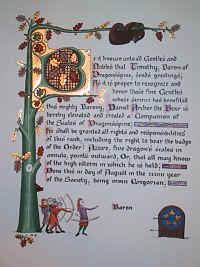
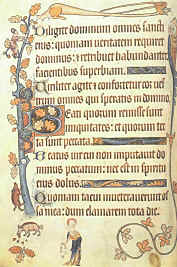
This scroll is based upon the style of the Luttrell Psalter, a personal prayer-book created in England in the early 14th century. This famous manuscript is well known for its depictions of rural life in the Middle Ages. The original is preserved at the British Library; The Luttrell Psalter (1989) by Janet Backhouse contains many photographs of the document. The scroll was created in July A.S. 37 (2002) for Baron's War; it was my seventh scroll, my first having been created in November A.S. 36 (2001).
Several pages from the Luttrell Psalter were chosen as inspiration. The overall design was taken from f. 59 verso, which is dominated by an oak tree in the autumn woods. The illumination was also designed to reflect the persona of the recipient, Daniel Archer the Bear, who is in fact an accomplished archer. The scene of archers along the bottom of the scroll comes from f. 147 verso. His arms — Vert, a bear and a lion combattant and a bordure embattled Or — inspired the color selection and the bear images on the scroll.
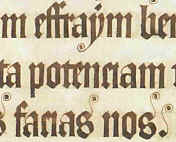
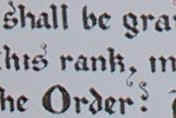
The hand used in the Luttrell Psalter is a modified Gothic, with early Versals used for the initial capitals. The flourishes unique to the Luttrell Psalter — such as the letter 's' and the spirals attached to the punctuation — were reproduced in the calligraphy for the scroll. The letters in the original manuscript are somewhat taller and narrower than the hand used on the scroll.
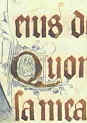
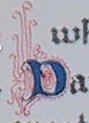
Many of the initial Versals in the Luttrell Psalter are surrounded with fine line work, or filigree. This embellishment was common in Gothic manuscripts and was usually done in a color complementary to the capital. Important capitals — such as in a person's name — were often written in red or blue to stand out and reflect the importance of the person.
The original manuscript was likely created using cut quills (usually goose) dipped in iron-gall ink, and written on vellum made from calfskin. Due to the high cost of calfskin vellum, modern paper was used instead — acid-free Bristol paper, chosen to preserve the work over time. A metal-nib dip pen was used in place of the quill to avoid the constant sharpening needed by quill pens. Permanent light-fast black ink was used for archival purposes instead of the period iron-gall ink, which is brown and turns black as it oxidizes.
Gold leaf was applied to the illuminated capital and several of the oak leaves. Gold leaf became common in the 10th-century Romanesque period and was very common in later Gothic manuscripts, although there was only a small amount of gold leaf used in the actual Luttrell Psalter. In period, a gesso made of slaked plaster, sugar, hide glue (or fish glue), and white lead would have been used. In the dry climate of Colorado such a mixture does not work well, so a modern substitute of acrylic gloss medium (sometimes called Hyplar) was used instead. Blowing gently on the dried acrylic size makes it tacky, and gold leaf is carefully laid over the surface and burnished until shiny.
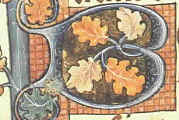
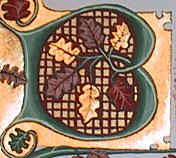
In the Middle Ages, many paints were made from very toxic materials — red contained lead or iron, yellow was made from orpiment (arsenic oxide), verdigris green contained copper and strong vinegar (or malachite). For the scroll, modern gouache was used. Although the actual chemicals are different and safer, gouache still consists of finely powdered pigments mixed with a binding agent such as gum arabic. The colors used on the scroll are representative of those throughout the Luttrell Psalter; greens and gold were chosen to match the recipient's arms while maintaining an autumn palette as in the original.
The shading, or "white work," on the scroll was done to match the examples in the Luttrell Psalter. A diluted white gouache was applied and blended into the base color using water; then a very fine brush was used with thicker white gouache for the white lines. This shading technique was also used on the line fillers, whose designs were also taken from the original manuscript.
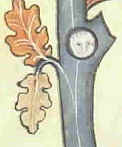
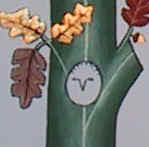


The scene of archers required a bit more complex shading, but the same technique was used. A fine metal "crow quill" pen was used with black ink to create the details in the faces and bows. In the Middle Ages an actual crow's quill would have been used due to its small size and stiffness, although a real crow's quill requires more frequent sharpening compared to the metal pen.
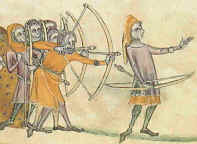
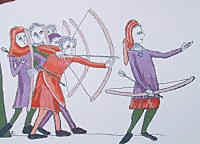
Since this was the first miniature scene I had ever attempted on a scroll, the original image was traced and then transferred to the scroll. That copy was then painted and outlined. The brown bear, hanging from the upper branch of the oak tree, was traced from The Hunting Book, a period hunting treatise by Gaston Phoebus. All other elements were created freehand without any tracing.
I'm very pleased with how this scroll turned out. It has given me great respect for the skills and artistic talents of the medieval monks and scholars who painstakingly created the illuminated manuscripts of the Middle Ages. I also enjoyed combining period elements to customize the scroll towards the persona of the recipient. In the future, I will continue to concentrate on improving the spacing of the calligraphy and will try producing original miniatures rather than tracing existing illustrations.
Bibliography
- Backhouse, Janet. The Luttrell Psalter. The British Library, London, 1989.
- Contains many photographs of pages from the original Luttrell Psalter.
- Bise, Gabriel. Medieval Hunting Scenes (the Hunting Book of Gaston Phoebus). Miller Graphics, New York, 1978.
- This treatise on hunting in the Middle Ages contains several photographs of drawings of animals and hunting scenes.
- Drogin, Marc. Medieval Calligraphy: Its History and Technique. Dover Publications, New York, 1989.
- One of the definitive sources for calligraphy in the Middle Ages.
- Thompson, Daniel V. The Materials and Techniques of Medieval Painting. Dover Publications, New York, 1956.
- Describes how various paints were produced in the Middle Ages.
- Cennini, Cennino d'Andrea. The Craftsman's Handbook (Il Libro dell' Arte). Translated by Daniel V. Thompson, Jr. Dover Publications, New York, 1966.
- Translation of a 15th-century painter's handbook; describes how various paints and gessos were made.